Push Back

Since launching my campaign to embed in Afghanistan I’ve received a lot of push back from my American friends who spent time outside the wire in Jalalabad with me. They are concerned that I’m placing myself in grave danger to cover a story that will end in dismal failure. They have little confidence in the Government of the Islamic Republic of Afghanistan (GoIRA) or the American military when it comes to solving the true problems driving the fighting country-wide. They also believe the military is incapable of telling the truth about the effectiveness of their efforts nor able to develop the tactical models required to deal with what is now a general insurgency.

One of them shared this observation in a group email a few days ago:

I remember something Sitting Bull said to Jim when Jim spoke of coming back and marrying into the tribe.  His response, “you’re not Muslim”.. So if ANYONE had a level of rapport with any Afghan who lives in the countryside, Jim did.  And for his counterpart to make that distinction after all they had been through, THAT means something.

He’s talking about Jim Gant who I consider the most remarkable soldier of our generation and a man I admire greatly. Jim was cursed by being successful where all others failed miserably and got the shaft for it but that’s another story for another post.

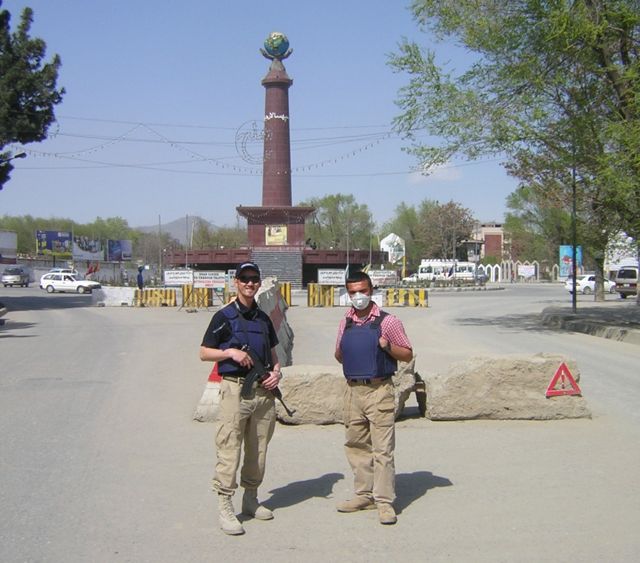
What’s ironic about that comment is (unknown by my friends) I’ve been asked to convert, marry into a tribe and stay in Afghanistan on four different occasions. Unlike Jim I was not talking with a tribal leader who loved me like a son; these men hardly knew me. They were trying to get another connected, educated, competent guy to join the tribe for the obvious benefits that would bring to the community. It is a typically Afghan thing to do in rural districts and I spent months at a time in remote districts accompanied by only an interpreter (Zaki or JD) and a driver. None of my friends (with the notable exception of Jim Gant and fellow Ghost Team members) have remotely similar experiences.

My colleagues from Ghost Team and I (along with a handful of westerners sprinkled throughout the country by marriage or business) are the only westerners who embedded inside local communities and directly supervised large projects that were completed on time and on budget. Consistent performance at that level required detailed knowledge of how local communities functioned. Projects had to be vetted correctly the first time, every time, to avoid the perception of favoritism of one tribe over another.
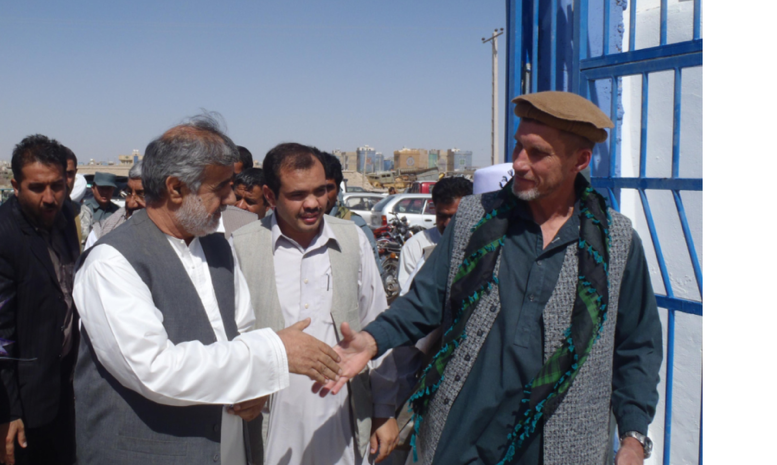
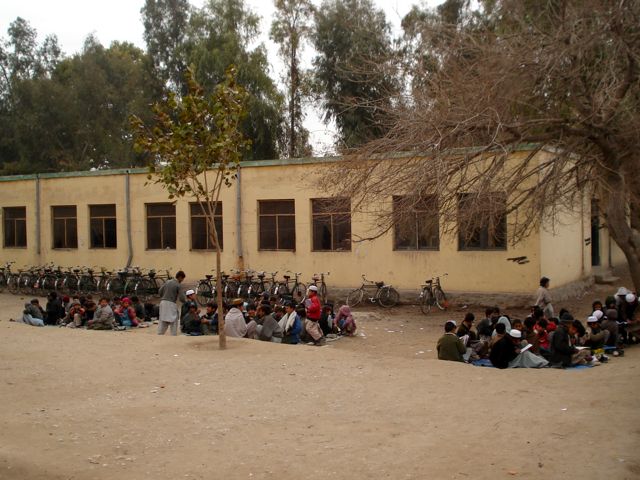
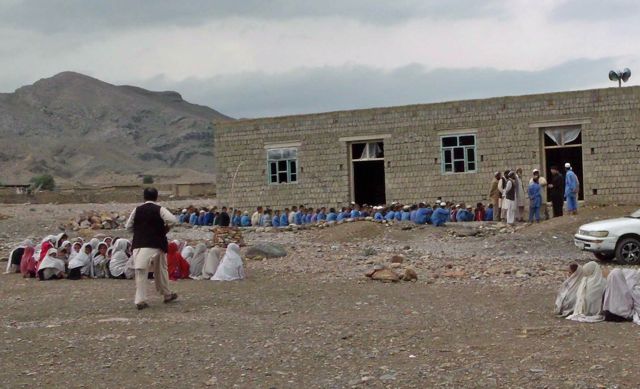
Another project completed on time, on budget, and 300 miles away from the closest American. Free Ranging is hard, can be dangerous but is also the most gratifying thing a westerner can do in Afghanistan.

I knew the tribes where we worked trusting them to protect our little team on nothing more than a hand shake. Free Ranging requires a high tolerance for risk, unshakable confidence in your ability to get through any situation along with the application of reason and logic to local atmospherics. Reason and logic allowed us to be comfortable operating in areas where everyone else was uncomfortable.  Reason and logic is why I’m comfortable going back. What is uncomfortable is being lectured by friends who don’t really know what I know. Which provides a perfect opportunity to discuss the realities of Free Ranging in contested lands.

Rule #1 is you will not be able to talk your way through every checkpoint. I was detained in Afghanistan, Dubai and the Northwest frontier of Pakistan during the years I spent Free Ranging. When pinched in Pakistan I was being driven through the town of Landi Kotal and was about 5 miles from the border. I was taken back to Peshawar (a policeman jumped in my cab to escort me and I had to pay for the ride back) where a magistrate released me on my own recognizance minus my cash, passport, and expensive (recently purchased) wristwatch. But I had my cell phone and called my friend (and manager of the Taj)  Mehrab who arrived (in the middle of the night) with enough cash to pay for a permit and escort to  get me through the Khyber Pass. I spent the intervening hours keeping a low profile in a crappy tea house and let me assure you I was terrified. Anyone who says they can handle that much risk and not be scared to death is delusional. But I kept my cool, remained calm and waited patiently.

If you ever found yourself alone, broke, tired and hungry in Peshawar, Pakistan, in the middle of the night, you might be a Free Ranger.
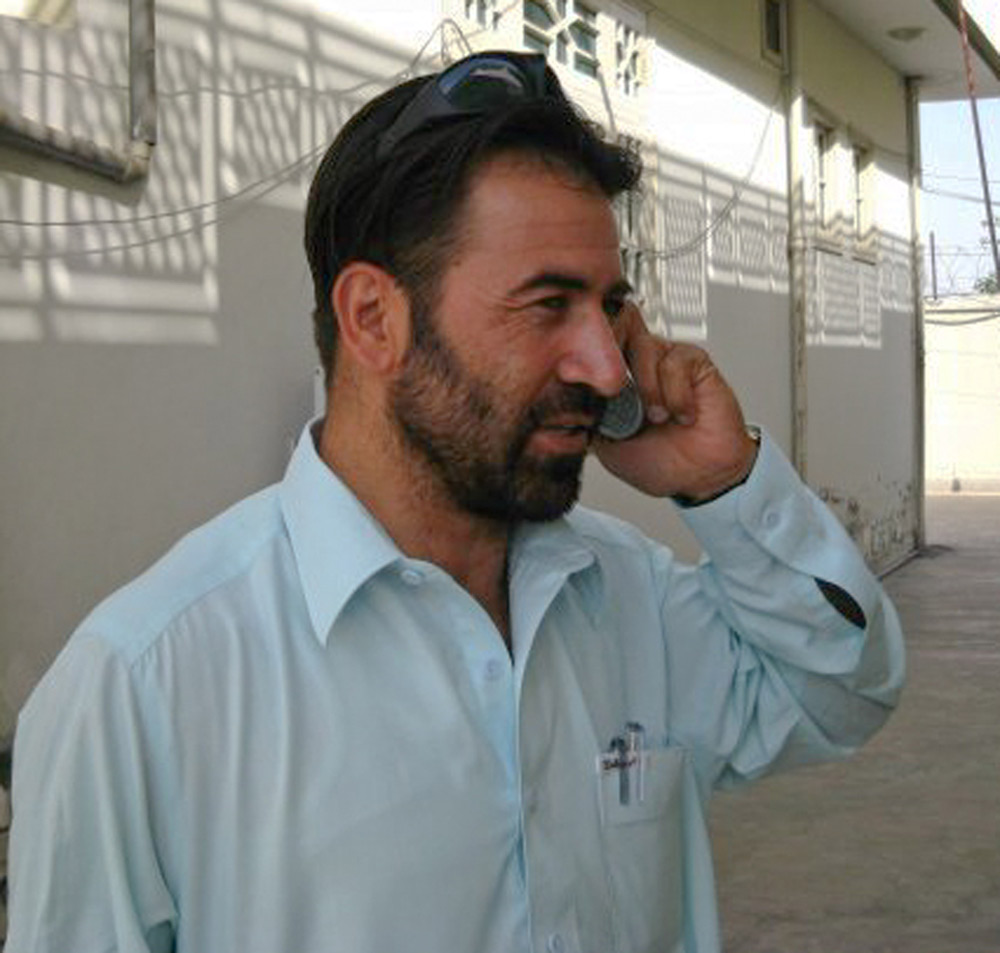
Mehrabudding Sirajuddin a good man who paid a high price for believing America was the strongest tribe. Photo by Michael Yon

Mehrab like many Afghans who worked with the international community was killed outside his house by Taliban gunmen in 2012. He was a good man who believed that the international community would bring peace and prosperity to Afghanistan. He also was a typical Afghan who would do anything to include transiting the Khyber Pass at night in the middle of the 2009 Khyber Pass offensive to help a friend in need. Meharb and the many Afghans I met who are just like him are the reason I want to go back.

The Free Range threat matrix, developed over a decade ago, is interesting reading for those unfamiliar with the realities on the ground in Afghanistan. It’s been updated for the embed this summer.

Free Range International Threat Matrix 2007

  1. Afghan Security Forces
  2. Motor Vehicle Accident
  3. Running into American or British army convoys while driving (high probability of getting shot even in Kabul and even in brand new up-armored SUV with diplomatic plates)
  4. Taliban ambush
  5. Serious disease or sudden illness

Free Range International Threat Matrix 2017

  1. Afghan Security Forces
  2. Motor Vehicle Accident
  3. Taliban ambush
  4. Serious disease or sudden illness

See the difference? Only the threat presented by ISAF road movements has been eliminated. Afghanistan is a scary place because the country is falling apart as a direct result of repeated failures by the international community to develop strategies that actually help the Afghan people.

Sixteen years down the road the Marines are going back because America has decided that we will, for the first time in my lifetime, actually see one of the debacles we created in a foreign land through to some sort of acceptable end state.

This story needs to be told honestly by a reporter who understands the Marines, the environment they are operating in and the degree of difficulty they will encounter as they balance force protection against mission effectiveness. Please take the  time to donate on my Go Fund Me page to enable honest, professional reporting on a story that will have a significant impact on your children’s future. Your kids may not be interested in war but war is interested in them. And if we cannot develop effective strategies to combat radical Islam war is going to find them.
Dawn Dreams About an Impending Nightmare

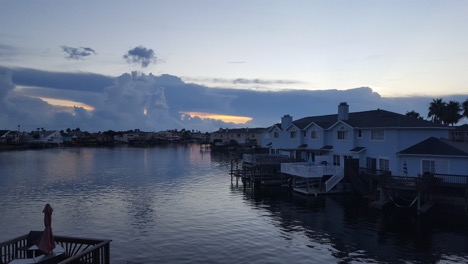
I’m sitting on my deck drinking coffee as the sun comes up. The sky is softening, and all the variations of reddish yellow (I can’t see them all with my red/green colorblindness, but can sense they are there) start creeping up from the dark horizon. A song is stuck in my head, and I hear it clearly: String Cheese Incident singing Arleen, not just any version of that song but the one they recorded live with the Dirty Dozen Brass Band.

PI

The song annoys me, and I try to clear my mind when the music suddenly stops. I’m hyper-alert; I remember this feeling and immediately flash back to Afghanistan. The daydream starts again, but now I’m considering the Afghan version of Baba Tim. What is he looking at when the sun comes up? What is he thinking about? The Afghan version of me would not have a String Cheese Incident song trapped inside his head, so what would be stuck there on a beautiful early morning?

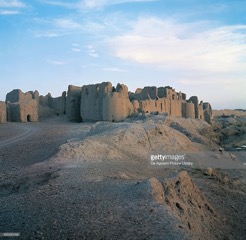
The answer flows into my consciousness without effort. As I look at the clouds building above the calm canals of Padre Island, I see an ancient fortress. This is not the famous Fighters Fortress of Mazar-e Sharif, the ancient Ghazni fortress, or the one built by Alexander the Great in Farah. The fortress the clouds are forming is the Boost Fortress in Lashkar Gah.

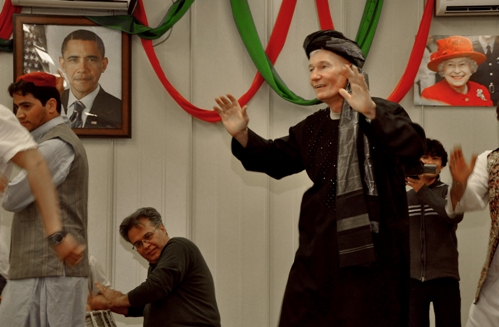
Lashkar Gah is the capital of Helmand Province and a town I know well, having lived there for over a year in 2010. Lashkar (soldier) Gah (fort) is an old military town occupied since the 11th century. It now houses over half a million refugees who have fled the encroaching Taliban. There is only a brigade of ANA soldiers in Lashkar Gah, and 100 American soldiers have just reinforced them. The Afghan version of Tim Lynch would focus on these men.
Boost

The Americans are trying to create depth to the ANA defense, and they are headquartered just down the road from the fort (the old Brit PRT base) on flat open terrain now surrounded by new housing built by the USAID and occupied by Taliban sympathizers. They will not be able to land helicopters at the base when we strike and will need to move to the Boost airport, miles of heavily populated neighborhoods away, to get to fixed-wing airplanes. It is during this move, during which we will negotiate a cease-fire to facilitate, that we will kill every American.

The Afghan version of me would be in his late fifties; active and fit, free of arthritis, gout, and disease, which marks him as a landholder and tribal leader. Farmers don’t reach their fifties with the blessings of good health in the Helmand Province. I carry scars from gunshot wounds and shrapnel, which means I’m Taliban (when it is covenant to be so), and the scars combined with my good health mark me as a man who has the one attribute admired by all Afghans – consistent good luck.

My new mission, passed to me by the Quetta Shura when the Americans arrived, is to destroy (to a man) an American unit. At this stage in the war, nothing else matters. The puppet government in Kabul is a dead man walking, not legitimate in the eyes of Afghans and, more importantly, not feared by the people. The central government is no longer a threat to the success of our movement.

I know the Americans have often met with senior Marine officers; I even have a picture with Senators John McCain and Lindsey Graham. When I met them, I smiled and thanked them for doing whatever they thought they were doing in Marjah. But I thought the two soft, fat, uninformed senators were not serious men. Politicians are the same regardless of land of origin; they are, in their hearts, cowards who demand others do the work while they amass personal wealth despite their limited government income. The Marines were a problem, but one of limited duration. We knew the day they arrived exactly what day they would be leaving, thanks to the African man who is the President of that land. After losing too many Mujahideen to the Marines early on, we decided to wait them out with IEDs and long-range fires.

Marjah

I am in my family compound, looking at the old Boost Fort as the sun rises, and I don’t have Widespread Panic songs locked inside my head. My mind is free of clutter and as clear as my mission.

I have many sons and three wives. My oldest son is a Taliban commander, and the next oldest is a captain in the Afghan army. Three of the younger boys are in Quetta at the madrasa, and my four youngest boys are squatting in the shade next to me, watching quietly. Afghan children do not initiate conversations with their elders, they aren’t loud, they don’t fidget, they don’t argue – they obey just as Allah would wish. Once I get confirmation of today’s American deployment, the boys will each be given a position where they will spend the day. They will get the Americans to feed them and give them bottled water if they are skillful. If they aren’t, they’ll go hungry. As their father, I couldn’t care less. The smart ones will grow true and strong, the weak or stupid ones will perish young. Allah decides that, not me.

My boys will be questioned closely when they return. How are the Americans acting? Are they jittery, unsure of their Afghan partners? Do they have the same confidence those damn Marines had when they were here or do they look more like the British? I know the answers to these questions already, but reconnaissance is continuous, as any change in the demeanor of the Americans would be significant. At this point, they are scared, unsure of their new allies and the civilians surrounding them. The smell of fear is strong when near an American position.
Soon my oldest will join me with the specialists we need from Quetta. Combat multipliers are what the Americans would call them but we call them Russians as they are from the former Soviet Union and are expert snipers and demolition men. The Mujahedin from Musa Qala and Sangin are arriving daily and with them the one item I cannot have enough of; 82mm mortar rounds.

Every police checkpoint attacked at night is a cover for smuggling mortar rounds into the city. While the puppet government soldiers and police fight off small probing attacks, our boats (manned by small boys so the American planes will not attack them) move back and forth across the Helmand River, bringing more mortar rounds. Survey teams from Quetta have spent the last fortnight establishing mortar firing positions. With firing tables and their computers, they have even locked in the elevation and deflection readings for the mortar crews. We Afghans can do shock and awe, too. When the mortars start opening up from every quadrant in the city, the Americans will be shocked. The awe will come when they realize they cannot use their planes or drones but will have to fight like men.

This evening, my boys, as will the others I have deployed over the city, will be back. My commanders and I will gather their information, adjust our plans, and wait for Allah. When Allah sends a sandstorm or a rainstorm or any storm that grounds the infidels’ aircraft, we will strike, and by the time the Americans respond with their planes, we will be among the people. Thousands of Mujahideen fighters surrounded by tens of thousands of civilians will make us immune to the American air power. We will have 100 American fish in our nets and kill them all. Unless there are women with them, they will be spared for use as entertainment for the Mujahideen. Then they will be destroyed.

If the Americans do not use their attack aircraft out of fear of killing civilians, I win. If they use their air power to destroy the attacking Mujahideen, they will kill thousands of women and children, so again, I win. Win/win – that’s the way of the Pashtun because if you are going to fight, you must win, or why bother fighting? If we capture an American officer, I will have to ask him this before he is beheaded. They have fought here for a decade with no chance of winning, and I wonder why they remain.

For now, we wait, watch, plan, and listen. Allah will give us the cover we need to strike. When all the mortar rounds are here, along with the Russians and the Mujahideen from the north, I will be one move away from checkmate. The Americans will not realize their peril because they play checkers; we play chess.

I am a 58-year-old Afghan, a 1,000-year-old Muslim, but a 6,000-year-old Pashtun. The Pashtun has one and only one way to deal with infidel invaders, and that is to isolate them and kill them to a man.  It’s what we do.

Save

Save

Save

Save

Save

Save

A War

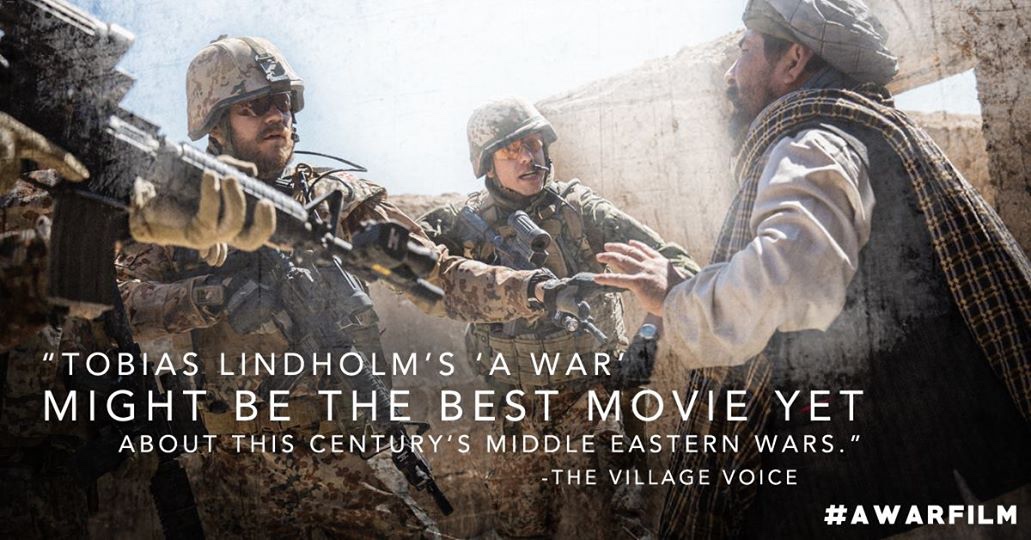
Our favorite Hollywood insider invited Free Range International (FRI), the lovely Kanani Fong, to review the film A War. As a reward, she put me in touch with an interview with the producer Tobias Lindholm. I set up on the Baba Deck, started the film, and when it was over, found myself just sitting in stunned silence, trying to figure out why this film had upset me. I emailed Kanani, who emailed the producer, who emailed me the info to watch it again (it’s a one-time password), and again I watched it, slowly, and began to understand what it was all about. This film should be required viewing for every idiot politician in the Western world who thinks it’s a great idea to nation build.

a war 2 copy

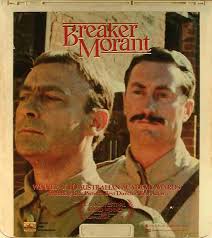
The cinematography, tight battle shots, clean storyline, and understated tone reminded me of another military classic, Breaker Morant. Breaker Morant exploded in popularity worldwide and garnered too many awards to list here. I hope A War will have a similar reception.

breaker morant copy

A War follows a Danish infantry company commander as his government prosecutes him over collateral damage he may or may not have inflicted (this is never really established) and the toll it takes on him and his family. That the civilians sitting in judgment of him have no idea of the pressures or realities facing their fellow countrymen on the battle field is an obvious plot line that is handled tactfully. Directed by the talented Tobias Lindholm and staring Pilou Aesbeck (Game of Thrones) with a supporting cast of unreasonably attractive Danish folks, the film sucks you in and never lets go.

The movie is based, in part, on the prosecution of a Danish company commander charged with the illegal killing of 4 men he contends were planting IEDs near a Danish base in the Helmand Province on the night of October 23, 2011. The Staff Judge Advocate dropped the charges when Task Force Helmand (the Brits) could not produce the evidence as promised. I think the issue was the source’s credibility or lack of a clean chain of custody from the source to the prosecutor. Regardless, the case never went to trial, but one can imagine the toll paid by the company commander in question.

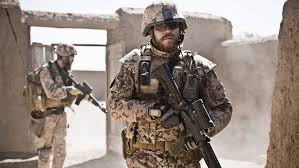
The first half of A War introduces the Danish company commander Claus Pederson (played by Pilou Asbæk) and shows why he has been charged with the deaths of civilians. We are introduced to the concept of PID (positive identification) during the exceptionally realistic combat scenes. We see the Danes paying scrupulous attention to their rules of engagement. We watch them allow armed Taliban to move through their area unmolested. When an armed Taliban stops his motorcycle to plant an IED, they plant him, from 500 meters out, with two rounds into the 10-ring. These lads were good infantrymen, patient, talented, and professional.

A War copy

During one of the ensuing patrols all hell breaks loose when the Danes are sucked into a village that turns out to be a complex ambush. To get a medevac flight in to take his wounded out, the CO (Pederson) calls in Tac-Air on one of the adjacent compounds from which he was taking fire. Weeks later, Staff Judge Advocate officers show up with some photos, allegedly from the targeted compound, of a dead woman and children. The company commander is immediately sent home to face trial for the deaths of these civilians.

At this point, the fact that the Taliban fire died off after the compound in question was hit is irrelevant – the issue becomes, did he know exactly who was in that compound when he smoked it, and that, of course, is a question that would be impossible for any human in his position to answer.

As the trial progresses, you want to hate the prosecutor and heap scorn or contempt on the three-judge panel, but that’s impossible. The court officers come off as intelligent, reasonable people doing their jobs to the best of their abilities. They wear sensible earth-toned natural fibers and ask reasonable questions. They are the kind of folks you’d like to hang out with in a fine restaurant, talking about art or culture for an evening.

What makes this movie work is the character of Claus Pederson. He is sending an important message aimed directly at veterans from both Iraq and Afghanistan. This was the producer’s intent, and he told me the idea for the film came after he read an article quoting a Danish infantry officer heading to Afghanistan for his third deployment. He was not afraid of dying at the hands of the Taliban, but terrified, given the stringent rules of engagement (ROE) of being prosecuted by the government when he returned.

As we watch Pederson dealing with his court martial, it is impossible to miss that he demonstrates the only helpful strategies available to combat veterans when returning home. You recognize that Pederson has the same dignified silence over the weight he carries that we saw in our WW II Veterans. Pederson is teaching essential lessons, the first of which is simple to say but tough to understand. When you get home from the wars, you’re alone and must deal with that. Even when surrounded by friends and family, you’re alone, and that won’t change until enough time has passed for the memories to fade.

This is revealed in a subtle way, which is why it comes across so powerfully. There are many times when Pederson is there but not there: when he slips out at night to stare at the stars and smoke a cigarette, or when he tracks a helicopter flying through the night skies. The moments are fleeting, and the camera doesn’t linger, but you know what he’s thinking, and for those of us who were there, we know we did the same thing when we first came home.

Then we witness another essential truth that Pederson unmasked: nobody cares or understands what happened to you. We see this in the reaction of Pederson’s wife when she learns of the dead children, the way the officers of the court remain unmoved by the detailed description of the desperate situation in which Pederson had to make instant decisions. They clearly don’t understand what he’s trying to tell them nor do they give a damn. Their concern remains only the concept of PID, not the reality that PID could never be established given the situation on the ground.

For the OIF/OEF combat vet, most people in your life will never understand, nor do they care about what you did during your rotation. Many are uncomfortable around you because you saw the elephant. They believe that seeing the elephant results in lifelong psychological problems because that’s what Hollywood tells them. It’s not true, but so often in America today, perception becomes reality when our media and Hollywood reinforce it.

The third, and by far most crucial lesson Pederson reveals is that every problem you are now facing was caused by decisions you made. Period. Nobody else is responsible, nobody else is to blame, and nobody else can fix whatever negative situation you are in. Your decisions got you where you are today; the only way out is on you.

Pederson is calm and collected while under enemy fire in Afghanistan and friendly fire in Copenhagen. He makes no apologies and holds no grudges even when his XO testifies honestly, yet damning. It is clear he is conflicted by his experience and feels responsible for the deaths of civilians, but not the woman and children he is being prosecuted for, but rather a family that had sought protection inside his Combat Outpost; something he could never allow.

This scene has played out many times during our years of fighting in Afghanistan. I talked with a Marine who had been at a Combat Outpost (COP) that took in a teenage girl who had been beaten and was going to be killed by her brothers for talking to another boy on the phone without their permission. The Marines took the girl in and reported this up the chain. It went to the embassy for a decision, and they decided to kick her out of the COP. The girl was released, and we can assume (but don’t know for sure) suffered a hideous death. The men who took her in and then were forced to kick her out have to live with that. I know the ambassador and his staff were no more thrilled about making this decision than I would have been, but let’s be honest; it was the right call in the grand scheme of things. I’d rather we stick to principle, but taking that girl in could have (I believe would have) resulted in a province-wide revolt. War forces men (and women) to make decisions right for tactical and strategic reasons, but wrong for the soul.

Back to the review:

At no time does Pederson bring up the fact that he was given a mission (the protection of local civilians from the Taliban) that he could never accomplish. Virtually every Afghan in the Helmand Province thought the foreigners were propping up an illegitimate government in Kabul. Nobody in that Province knew what 9/11 was, who al-Qaeda was, or why the foreigners were in their country. What they did know was that the government in Kabul was corrupt and the foreigners were responsible for standing that government up.

If you’re a vet, friend, or family member of an OIF or OEF vet, you must watch A War. Claus Pederson will show you what it was like to fight in Afghanistan. More importantly, for vets and their families, he will show you the way forward when you return.


Kandahar Rocks

This is a post from March 2010 re-posted now as a reminder of how unstable most of Afghanistan has become in the past five years. There was a Taliban attack outside of the Kandahar Airport that killed over 50 people (Cartman says 61 in his reporting) two days ago. For those of us who spent time at Kandahar it is hard to imagine a two- day siege going down just outside the wire. There are Americans still stationed at that airfield today and one has to wonder just how secure they can be given their reduced numbers. There was a time when internationals who knew what they were doing could operate safely even in kinetic places like Kandahar and this is a story from that time…it didn’t have to end this way.

I’m still on the road trying to make my way back to Jalalabad from a big implementation working group meeting in Lashkar Gah. Step one of the journey back was to hitch a ride to Kandahar where Panjawaii Tim promised to pick me up and take me out to his compound for the night. It is a large, comfortable place which has something I have been looking forward to… cold beers. The plane was late which was annoying – driving around Kandahar at night is risky. But there’s cold beer and piss up at stake so this trip was obviously mission essential.

We were delayed getting across the Tarnak River bridge by an American convoy – the bridge was blown up a few days back and the convoy was trying to maneuver around it in the river bed. Michael Yon has the story about the loss of that vital bridge here.  It turns out the delay was a good thing because as we cleared the bridge area and headed towards the city the sky in front of us lit up like a flashbulb. “That’s not good,” said Tim as his cell started to ring. The boys back in the safe house reported a large explosion in the vicinity of the Karazi compound about 300 meters west of our destination. Then we saw what looked like a smaller (yet still pretty impressive blast) followed by another very large boom. Then Tim’s cell phone went dead, which was completely uncool. The the night sky just lit up with a few more big bangs and we both shut up – I reached into the back seat for a long gun; the shit I’ll go through for cold beer….I’m retarded.

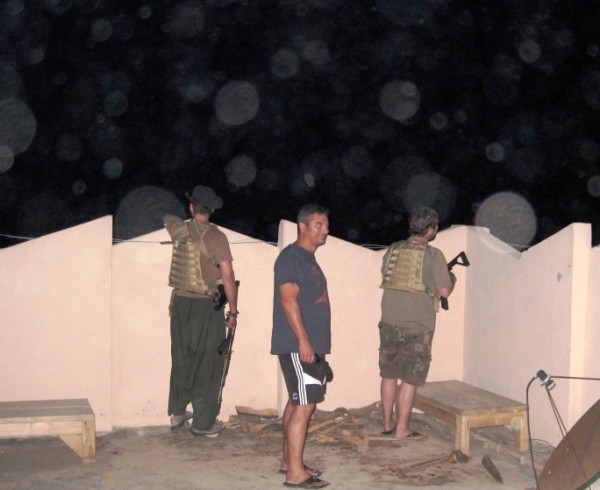
The boys standing to on the roof of the Team Canada safe house. Of course I did not have my good camera so this shot looks like crap. The four expolsions bracketed this house on three sides and were very close.
The boys standing-to on the roof of the Team Canada safe house. Of course I did not have my good camera so this shot looks like crap. The four explosions bracketed this house on three sides and were very close.   There was still a lot of small arms fire going off when this shot was taken – seemed to us to be coming mostly from the Afghan security forces.

We were entering the city by then and could see an American QRF force racing towards the area where most of the international compounds, Afghan government offices, the Sarposa prison and our safe house are located.  The roads were being cut by Afghan Security Forces (ANSF) and during times like this trying to talk your way through security checkpoints is a bad idea so we switched to plan B. Panjawaii Tim knows Kandahar like I know Jalalabad; he started working his way through side streets that were full of people milling about looking towards the blast clouds. There were lots of broken store windows the closer we got to home; in fact all of them were broken as we worked our way parallel to the main road closer to the area targeted in the attacks. We had to clear only one ANSF checkpoint  – it is always funny to see the police react when Tim and I drive up in local garb with our ISAF (contractor) ID’s and tell them we’re with ISAF and need to get through. They get confused when we start talking Pashto and look at us like we’re ghosts, or Jinn, or just plain crazy.

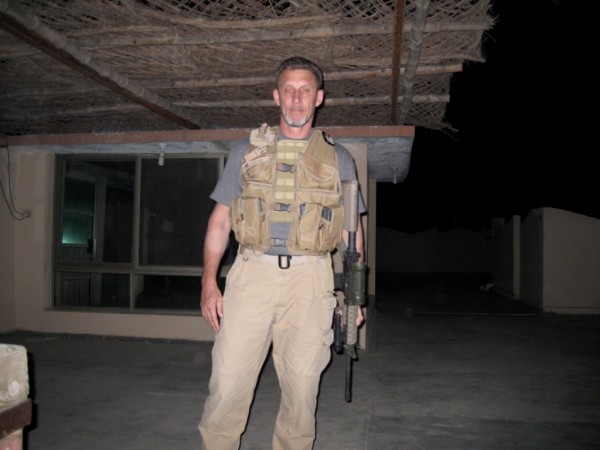
One of the Team Canada guys is on leave so I was given his kit to use tonight - a poor shot I know - my little pocket camera sucks
One of the Team Canada guys is on leave so I was given his kit to use tonight – don’t know what is going on with me eyes in this picture – my   pocket camera sucks

Here is Panjawaii Tim’s report on the incident:

“The first bomb was at the Al Jadeed market: 10-20 killed, unknown number injured; second was a large bomb at the Sarpoza prison.   20 -30 killed and 100 injured allegedly; third was the bomb near PHQ, unknown number injured/killed; fourth was bomb near Mandigak mosque, unknown number injured killed. First bombs lured the ANP response out of PHQ and then they were hit. US and CDN units seen responding with ANSF assets. No reports of a prison break at this time. We heard Taliban propaganda broadcast over a megaphone in our neighborhood within half hour of attacks. Many ambulances and other vehicles seen transporting casualties to Mirwais (Chinese) Hospital.”

You know what all this means?  It means no sitting on the roof and drinking cold beers with my buddies. It also means that I have to get up in the middle of the night to pull sentry duty. Fucking Taliban; killing civilians for no damn reason, damaging people’s stores and homes for no damn reason, and spoiling what looked to be a good piss up.   I hate them.

Gandamak

Last week I received a polite email from Professor Richard Macrory of the Centre for Law and the Environment, University College London, asking me for permission to use some of my photos of the Gandamak battlefield in his upcoming book on the First Afghan War. I said it would be an honor, and I believe the book will come out next year. In the meantime, I’m re-posting my Gandamak story because it differs from every other Gandamak story from Afghan-based expats. This Gandamak tale is about the battlefield, not one of the best bar/guesthouses in Kabul

Traveling into contested tribal lands is a bit tricky. I had no doubt that the Malicks from Gandamak would provide for my safety at our destination but I had to get there first. Given the amount of Taliban activity between Jalalabad and Gandamak the only safe way to get there and back was low profile.

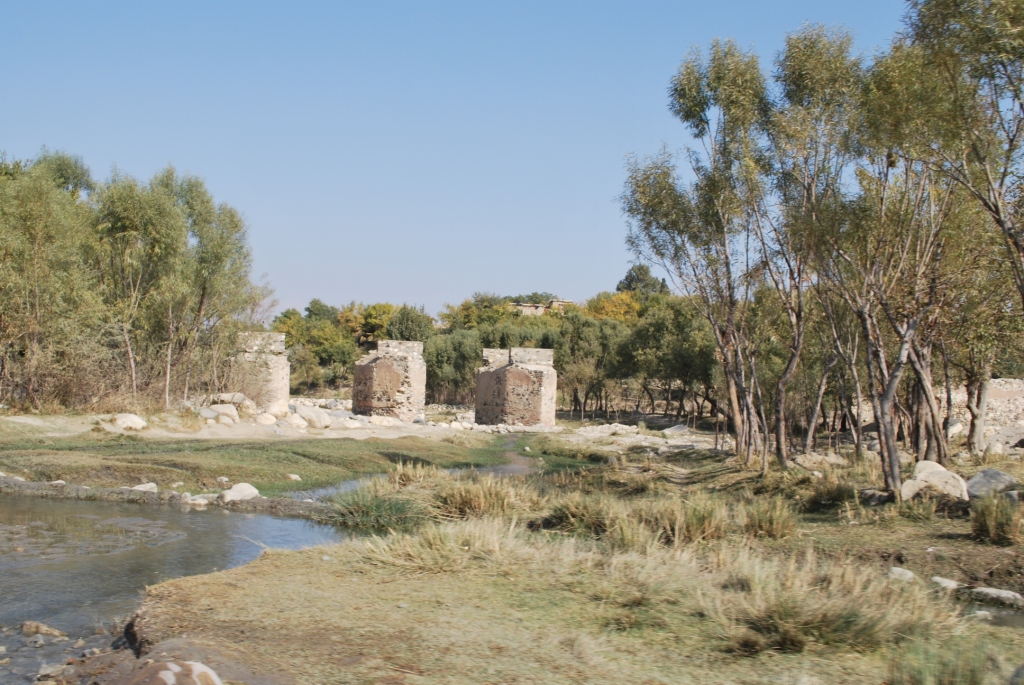
The first of three downed bridges between Gandamak and Jalalabad

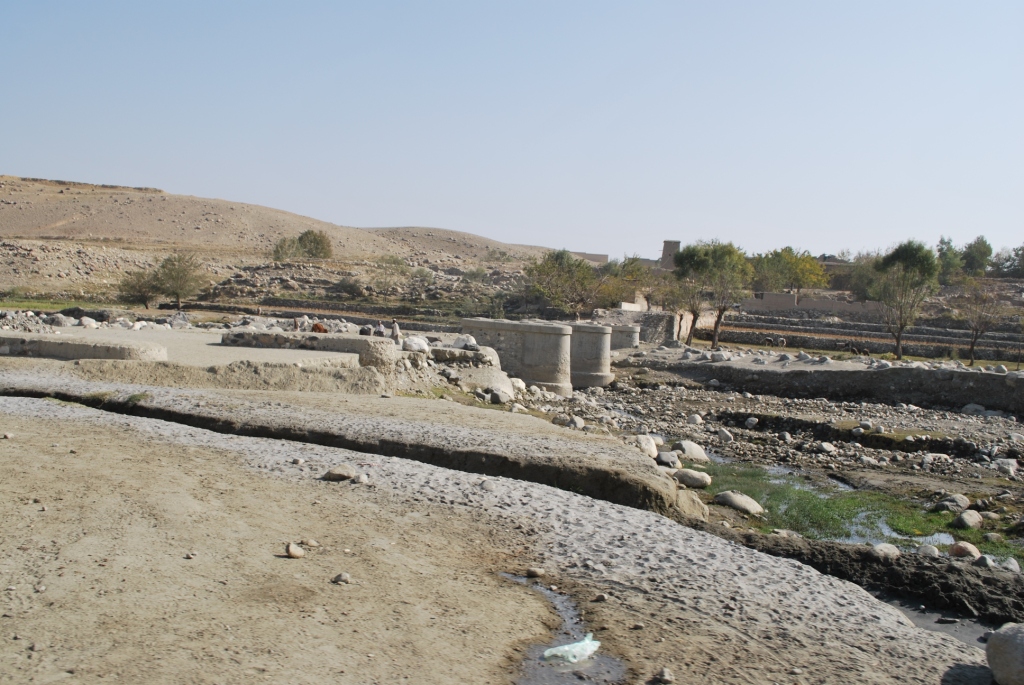
The road into Gandamack required us to ford three separate stream beds. The Soviets destroyed the bridges that spanned these obstacles around 25 years ago. We have been fighting the Stability Operations battle here for seven years, but the bridges are still down, the power plants have not been fixed, and most roads are little better than when Alexander the Great came through the Khyber Pass in 327 BC. The job of repairing and building the infrastructure of Afghanistan is much bigger than anyone back home can imagine. Given their current operational tempo and style, it is also clearly beyond the capabilities of USAID or the US Military PRTs to fix it. These bridges are still down (as of 2015) and may never be fixed in our lifetimes.

Also destroyed 25 years ago - how do we expect the farmers to get their produce and livestock to market over this? What the hell have we been doing for the past seven years? I watchd the tallest building in the world go up in Dubai, with about 300 other super sky scrappers over the past four years but we can't even repair a few stone bridges in seven; check that, make it 14 years?
Also, it was destroyed 25 years ago—how do we expect the farmers to get their produce and livestock to market over this? What the hell have we been doing for the past seven years? I watched the tallest building in the world go up in Dubai, with about 300 other super skyscrapers over the past four years, but we can’t even repair a few stone bridges in seven; check that, make it 14 years?

It took over an hour to reach Gandamack, a prosperous hamlet tucked into a small valley. The color of prosperity in Afghanistan is green because vegetation means water, and villages with abundant clean water are always significantly better off than those without.

My host for the day was the older brother of my driver, Sharif. When I first met Sharif, he said, “I speak English fluently,” and smiled. I immediately hired him and issued a quick string of coordinating instructions about what we were doing in the morning, then bid him good day. He failed to show up on time, and when I called him to ask why, it became apparent that Sharif only knew the words “I speak English fluently.” You get that from Afghans. But Shariff is learning his letters and has proven an able driver, plus a first-rate scrounger.

The Maliks (tribal leaders) from Gandamak and the surrounding villages arrived shortly after we did. They walked into the meeting room armed; I had left my rifle in the vehicle, which, as the invited foreign guest, I felt obligated to do.  Gandamak is Indian Country, and everybody out here is armed to the teeth.  I was a guest; the odds of my being harmed by the Maliks who asked me were zero. That’s how Pashtunwali works. The order of business was a meeting where the topic was what they needed and why they couldn’t get help. Then we were to tour the hill outside Gandamak where the 44th Foot fought to the last man during the British retreat from Kabul in 1842, followed by lunch. I could not do much about the projects they needed, but I could listen politely, which is all they asked of me. Years later, I could lend them a hand when they needed it, but I was a security guard, not an aid guy at the time of this meeting.  

Sharif's Great Great Grandfather and son waiting on the Brits to make it down from Kabul
Sharif’s great-great-grandfather and son were waiting for the Brits to make it down from Kabul.

As the Maliks arrived, they started talking among themselves in hushed tones, and I kept hearing the name “Barack Obama.” I was apprehensive; I’m surrounded by Obama fanatics every Thursday night at the Taj bar. Talking with them is unpleasant because they know nothing about the man other than that he is not Bush and looks cool. They are convinced he is ready to be president because NPR told them so. Pointing out to the NGO girls that Obama can’t possibly be prepared to be the chief executive because he has zero experience in executive leadership is pointless, and I did not want to have to explain this to the Maliks. They have time and will insist on hashing things out for as long as possible to reach a clear understanding. I have a wrist watch and a short attention span; this was not starting well.

As I feared, the morning discussion started with “Tell us about Barack Obama?” What was I to say? His thin resume is a problem, but he has risen to the top of the democratic machine, and that took some traits Pashtun Maliks could identify with. I described how he came to power in the Chicago machine. Not by trying to explain Chicago, but in general terms, using the oldest communication device known to man, a good story. A story based on fact, colored with a little supposition, and augmented by my colorful imagination. Once they understood that lawyers in America are like warlords in Afghanistan and can rub out their competition ahead of an election using the law and judges instead of guns, they got the picture. A man cold enough to win every office he ran by eliminating his competition before the vote is a man the Pashtuns can understand. I told them that Obama will probably win and that I have no idea how that will impact our effort in Afghanistan. They asked if Obama was African, and I resisted the obvious answer: Who knows? Instead, I said his father was African and his mother a white American, and so he identifies himself as an African American. I had confused my hosts, and they just looked at me for a long time, saying nothing.

What followed was (I think) a long discussion about Africans; were they or were they not good Muslims? I assume this stems from the Africans they may have seen during the Al Qaeda days. I think the conclusion was that the Africans were like the Arabs and therefore considered suspect. They talked among themselves for several more minutes, and I heard John McCain’s name several times, but they no longer asked about the pending election, praise be to God. They assured me that they like all Americans regardless of hue, and it would be better to see more of them, especially if they took off the helmets and body armor, because that scares the kids and woman folk. And their big MRAPS scare the cows who already don’t have enough water and feed, so scaring them causes even less milk to be produced, and on and on and on; these guys know how to beat a point to death.

We talked for around 35 more minutes about the anemic American reconstruction effort, their needs, and the rise in armed militancy. The American military visits the district of Sherzad about once a month and remains popular with the locals. They have built some micro-hydro power projects upstream from Gandamak, which the people (even those who do not benefit from the project) greatly appreciate. The US AID contractor DAI has several projects in the district, which the elders feel could be done better if they were given the money to do it themselves, but despite this, DAI is welcomed and their efforts are much appreciated. When I asked who had kidnapped the DAI engineer (a local national) last month and how we could go about securing his release (which was another reason for my visit) they shrugged and one of them said “who knows”?  That was to be expected, but I felt compelled to ask anyway. They know I have no skin in that game and am therefore irrelevant.

The elders explained, without me asking, that they are serious about giving up poppy cultivation, but they have yet to see the promised financial aid for doing so and thus will have to grow poppy again (if they get enough rain, inshallah). They also need a road to transport their crops to market once their fields are productive. Then they need their bridges repaired and their irrigation systems restored to the condition they were in in the 1970s, and that’s it. They said that with these improvements would come security and more commerce. One of them commented most interestingly: “The way the roads are now, the only thing we can economically transport over them is the poppy.” A little food for thought.

At the conclusion of the meeting’s talking part, the senior Maliks and I piled into my SUV and headed to the Gandamak battlefield.

The Last Stand of the 44th Foot

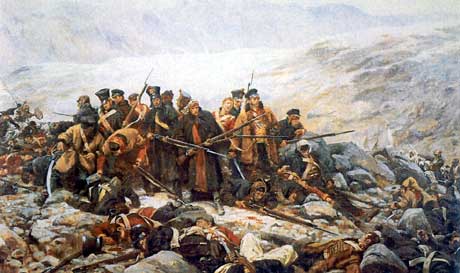
The final stand at Gandamak occurred on the 13th of January 1842. Twenty officers and forty-five British soldiers, most from the 44th Foot, pulled off the road onto a hillock when they found the pass to Jalalabad blocked by Afghan fighters. They must have pulled up on the high ground to take away the mobility advantage of the horse-mounted Afghan fighters. The Afghans closed in and tried to talk the men into surrendering their arms. A sergeant was famously said to reply, “Not bloody likely,” and the fight was on. Six officers cut their way through the attackers and tried to make it to British lines in Jalalabad. Only one, Dr Brydon, made it to safety.

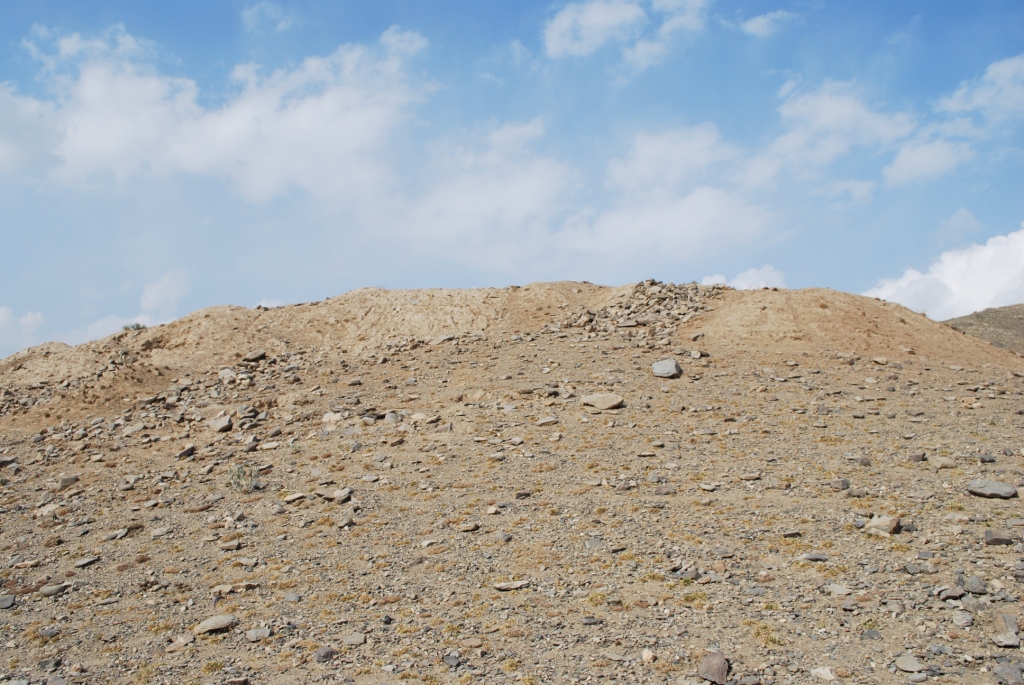
The Gandamack Hill today

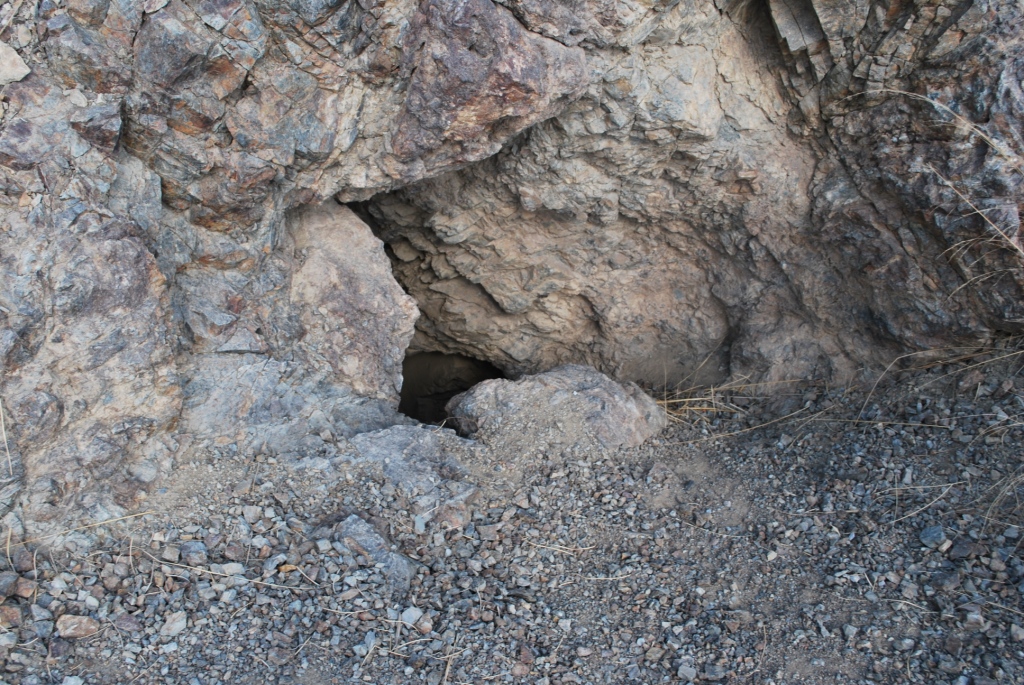
Our first stop was at what the Maliks described as “The British Prison,” which was up on the side of the Jalalabad pass about a mile from the battlefield. We climbed up the steep slope at a vigorous pace set by the senior Malik. About halfway up we came to what looked to be an old foundation and an entrance to a small cave. They said this was a British prison. I can’t imagine how that could be – there were no British forces here when the 44th Foot was cut down, but they could have established a garrison years later, I suppose.  Why the Brits would shove their prisoners inside a cave located so high up on the side of a mountain is a mystery to me, and I doubt this was the real story behind what looked to be a mine entrance.  It was a nice brisk walk up a very steep hill, and I kept up with the senior Malik, which was probably the point of this detour.

Enterance to the "Brit Jail
Entrance to the “Brit Jail

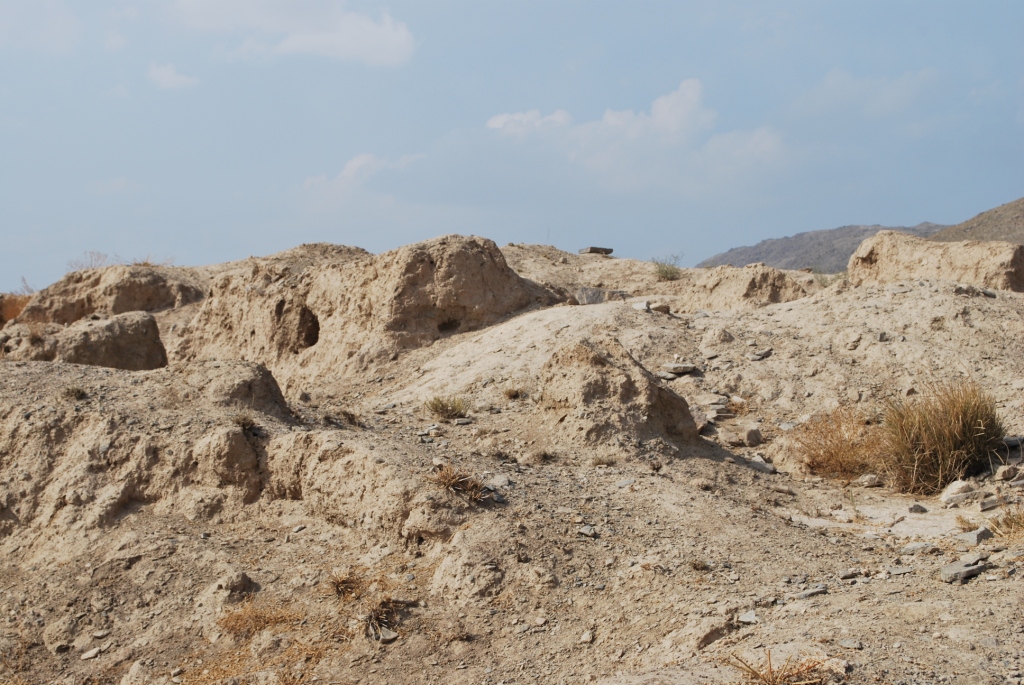
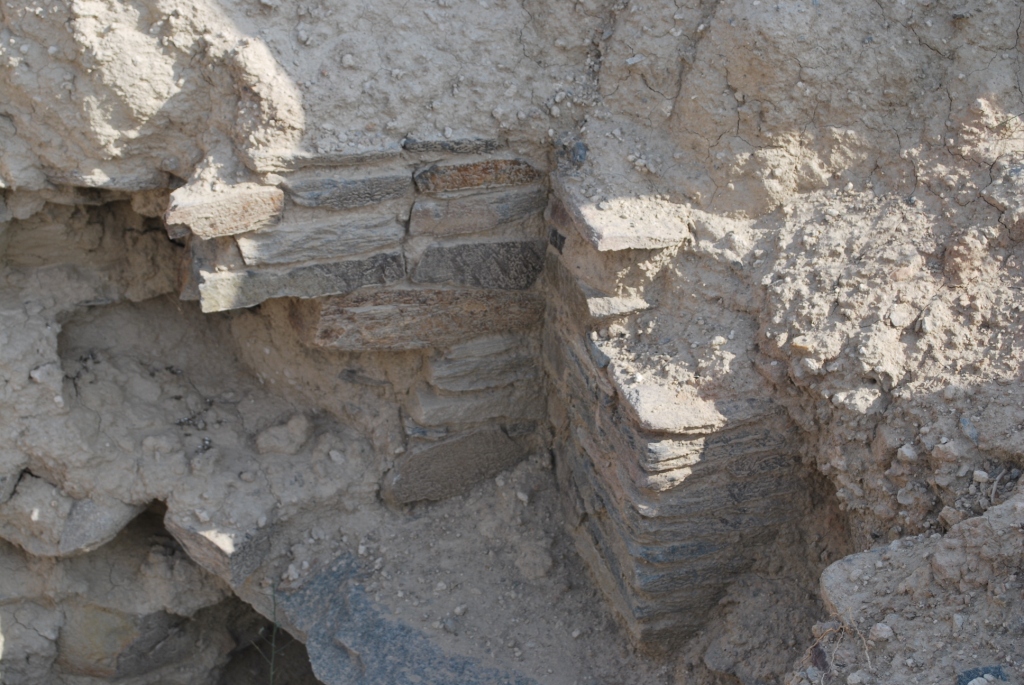
After checking that out, we headed to the battlefield proper. We stopped at the end of a finger, which looked exactly like any other finger jutting down from the mountain range above us. It contained building foundations that had been excavated a few years back. Some villagers started digging through the site looking for anything they could sell in Peshawar shortly after the Taliban fell. The same thing happened at the Minaret of Jamm until the central government sent troops to protect the site. The elders claimed to have unearthed a Buddha statue at the Gandamak battlefield a few years ago, which they figured the British must have pilfered from Kabul. By my estimation, there are 378,431 “ancient one-of-a-kind Buddha statues” for sale in Afghanistan to the westerner dumb enough to buy one. Their excellent fakes, and they better be, because the penalties for trafficking ancient artifacts are severe in Afghanistan.

I do not know where these foundations came from. In 1842, the closest British troops were 35 miles away in Jalalabad, and there are no reports of the 44th Foot pulling into an existing structure. We were in the right area – just off the ancient back road to Kabul via the Latabad Pass. My guides were certain this finger was where the battle occurred, and as their direct ancestors participated in it, I assumed we were on the correct piece of dirt. I would bet that the foundations are from a small British outpost built here, possibly to host the Treaty of Gandamak signing in 1879 or to recover the remains of their dead for proper internment.

Site of the final battle


Foundation from an unknown building on Gandamak Hill
Foundation of an unknown building on Gandamak Hill

The visit concluded with a large lunch, and after we had finished and the food was removed, our meeting was officially ended with a short prayer. I’m not sure what the prayer said, but it was brief. I’m an infidel; short is good

Post Script

The Maliks of Sherzad district never received the attention they wanted from the US Government or the Afghan authorities. Instead, the Taliban came to fill the void and started muscling their way into the district back in 2011. By early 2012, things were bad enough that my old driver, Shariff, called me to see if there was anything I could do about getting the Americans to help them fight off the encroaching Taliban fighters.  I was in the Helmand Province by then, dealing with my own Taliban problems, and could offer him nothing. That bothered me then and bothers me now, but that’s life.

In August 2012, my old friend Mehrab was gunned down by the Taliban outside his home. By then,, several of the men I had shared a pleasant lunch with back in 2008 had also perished fighting the Taliban. Gandamak is now Taliban territory, and the poppy is now the main source of income. It will be long before a Westerner can revisit the old battlefield.

Spiking The Ball

Last night I was coming back from the La Taverna du Liban, Kabul’s best Lebanese Restaurant, located in the Wazar Akbar Khan section of Kabul.  Back in the day it had a full bar and open patio and was packed with expat customers. Most of the expats back then had at least a pistol on them and senior diplomat types had heavily armed, high end expat guards sitting at the table next to them. Those days are long gone; now you have to walk down a long blast proof hallway through a series of locked doors and that’s after being searched for weapons curbside. The La Taverna du Liban, like most of the restaurants in Kabul, no longer allows armed Expats. The Afghan government and UN say the lack of armed westerners makes everyone safer. I say it makes them sitting ducks but I still go to the Taverna cause I love the place and the owner is a friend.

They still serve great food and have a good double apple shesha mix but now when the waiter takes your order he’ll wink and ask if would you like the red chai?   That’s code for red wine and it arrives in a teapot with tea mugs.  The days of having an open bar are behind us in Kabul restaurants too. When my Afghan friend Cartman and I were coming home last night we saw a dozens of riot police from the ANP cutting the road to the interior ministry and Serena Hotel. The cops didn’t have riot helmets or shields but they did have their batons which is a hint to their mission that night.  The only way Afghan drivers will pay attention to the police is if they believe failure to comply will result in a wood shampoo. Last night it was clear the cops were ready to administer wood shampoos to anyone ignoring their road block and that is most unusual.

Cartman’s phone rings and I hear the voice of an international reporter, attractive female type, who I don’t know that well.

“Boss, she wants to know if Obama is coming to talk to Karzai” asked Cartman.

“Tell her it is a gross breach of etiquette for her to talk to an Afghan male who is not a member of her immediate family.”

“She said your blog sucks and to shut up because she’s not asking you”.

The question sure put what I was seeing in context. The local cops don’t come out at night and cut roads unless something big is up.

It turns out the Commander in Chief was on the ground for a secret visit that obviously wasn’t too secret and one has to wonder if we might want to think of re-branding the Secret Service because they can’t keep a damn thing secret anymore.

The president was on the ground in Bagram Air Base pumping up the troops but (according to NPR) not spiking the ball on the one-year anniversary of his “gutsy” call to send a crew of hardened sailors into Pakistan to whack OBL.  Recently that gutsy call has been in the news…something about Mitt wouldn’t have made it and I guess there is a MSM video of the VP making an ass out of himself describing how the difficult decision was made. Mitt batted the sleazy allegations leveled at him out of the park and then the real story behind the decision to whack OBL came out and it looks to me like our POTUS came as close to voting present as is possible with a presidential finding.

Next thing you know we have a not so secret, secret visit where the Prez pumps up the troops and then last night sneaks into Kabul to ink a really, really, great deal with President Karzai. But none of this had anything to do with the anniversary of killing OBL because the president said so himself .

The Taliban decided that they too were not going to not observe the one year anniversary of OBL’s demise by conducting another well planned, poorly executed, attack inside the Kabul Ring of Steel (my guys call it the Ring of Steal).  The tactics were standard; a VBIED at the gate, followed by a ground assault by gunmen disguised by burkas. The target a bit ambitious, it’s called Green Village and is a privately owned FOB (Forward Operating Base) designed to provide ISAF level security to internationals who are not living on one of the military FOB’s. The results were predictable; the attackers rapidly isolated, this time rapidly dispatched, their intended targets unscathed and a bunch of innocent civilians  (mostly children) killed or injured.

Most international guesthouses in Afghanistan meet the UN Minimum Occupational Safety Standards (UN MOSS) but Green Village far exceeds UN MOSS because its intended clientele is the US Government not stingy, tight wad NGO’s. Opened in 2008 the place has never stopped growing. It is always at 100% occupancy, has great food, a decent gym, racquetball courts, a bar, pool, and all sorts of kiosks selling local goods and other stuff. I don’t care for the place myself because its pre-fabricated high-end feel combines everything that is wrong about our efforts in Afghanistan and confines it in a small artificially nice place. We have called it Menopause Manor for years because of the unending stream of reporting (mostly generated by the residents) saying the Taliban are targeting them.

This morning the Taliban were not able to talk their way past the gate guards so they blew their VBIED on the road at exactly the time when one would expect 200 to 300 school children to be walking by.

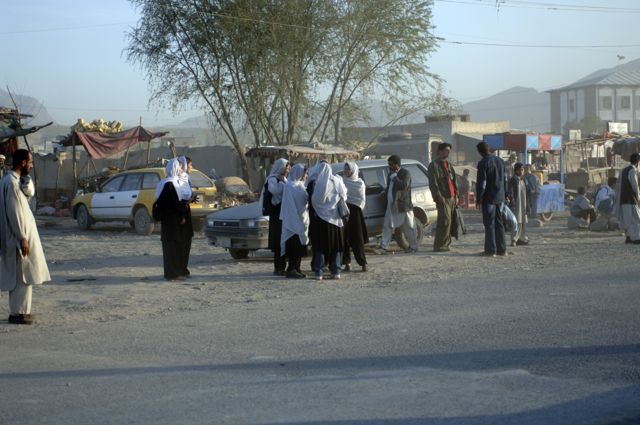
This is a picture from 2005 of kids waiting for their school bus on the corner of Jalalabad Road and the Green Village road. There are hundreds more children walking to schools along that road every morning now. At least one of those killed and many of the wounded today were school children.

The VBIED was followed up by three-man assault force who approached their objective wearing burkas and started battling with the Serbs and Nepalese guards from the Green Village guard force.

One of the three attackers blew himself up, another was gunned down and the third made it into the laundry building which is still well outside the blast walls of the main camp. The Kabul PD Critical Response Unit took the last one out soon after arriving on the scene. This was a typical Taliban attack – good planning, excellent operational security, poor execution coupled to a complete disregard for collateral damage.

The planning was pretty impressive because Green Village is the only privately run FOB in the country that houses ISAF contractors and troops. It would be, by far, the easiest ISAF FOB in the country to attack but only if you could sneak a rifle company into Kabul. One VBIED and three suicide bombers is not really an attack; it’s a statement. Like the last attack in Kabul it was successful only because it happened. The tactical failure of the assault force is, as it always is here, irrelevant.

Here are (in my humble opinion) the lessons learned from this latest attack.

The President’s schedule was compromised to the mainstream media. The planning for his visit was excellent; in around 2000 out by 0400; which allowed the downtown to be cleared and the President to meet with Karzai while causing minimal disruption to local residents. But I knew he was coming before he arrived because the MSM phone call put what I was witnessing downtown into context. It appears I wasn’t the only one in on the secret.

This dispatch came in from Taliban central on twitter today:

Al Farouq spring offensive will be launched on May 3 all over Afghanistan.  The Taliban said the code name came from Islam’s second caliph, Omar al Farouq known for his military advances in Asia and the Arab world during the seventh century.

The announcement comes hours after Taliban insurgents armed with guns, suicide vests and a bomb-laden car attacked a heavily fortified compound used by Westerners in Kabul, killing seven people and wounding more than a dozen.

The militants claimed the attack in defiance of US President Barack Obama’s call that the war was ending during a visit to Afghanistan on the first anniversary of Osama bin Laden’s death on Wednesday.”

Did the Taliban launched one of their pre-planned attacks a day early because they discovered that Obama was in Kabul? The attack happened two hours after the POTUS left and that means two hours after all the elite police units in the capitol went off duty after being up all night because he was here. That’s a pretty impressive reaction time by the Taliban and it demonstrates the danger of allowing administration operatives to leak details of Presidential trips to preferred members of the MSM.

The reaction to today’s attack by the people inside Green Village was also impressive when compared to the attack on the ISAF HQ last fall.  None of the residents, many of whom are EUPOL police officers or ISAF troops and therefore have weapons, ran out to the walls to start shooting wildly in the general direction of attack. They let the guard force do its work which, I understand, is a drilled SOP at Green Village. This reinforces the point that there is nothing, not one damn thing, big government can do more efficiently and effectively then the private sector and that includes repelling ineffective insurgent attacks on FOB’s hosting government troops.

The Afghans are hosed; the agreement Obama came into Kabul to sign last night is long on promises but short on specifics. The level of funding for ANSF he is promising has to be approved every year by congress and what are the chances that they decide to cut it at some point in the future?

Our involvement in Afghanistan is not going to end well. I predict we will pull all of our military out in 2014 just like we did Iraq in 2011.  There will be no “force enablers” and, unlike Iraq, there will be no massive international Private Security Company presence to enable continued reconstruction.We will pull all our forces out and with them will go the reconstruction piece and when that happens the world bank will no longer support the Afghani. The Afghani will then free fall just like the Zimbabwean dollar while the country erupts in civil war.

I have made many grim predictions on this blog over the years (my take on the so called Arab spring comes immediately to mind) and I always use the caveat that I hope I’m wrong.  So, I hope I’m wrong about Afghanistan’s future but I doubt it.

All Clear

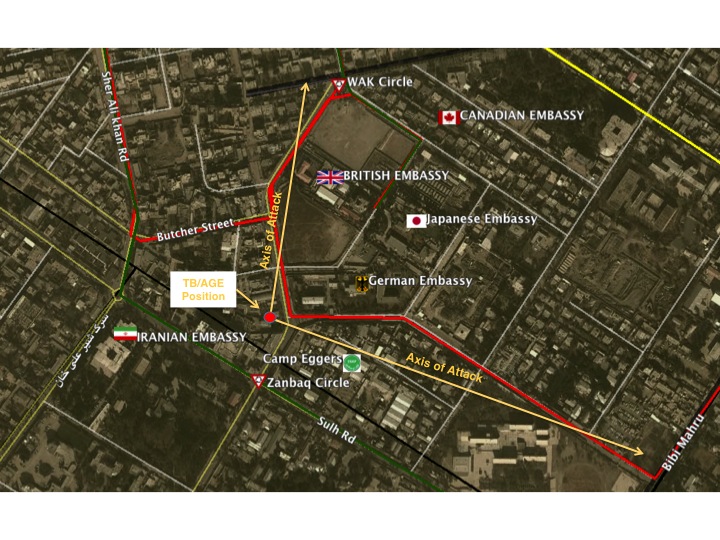
At 0630 this morning, Afghan National Security Forces (ANSF) in the form of the Kabul Critical Response Unit (CRU) finished off a crew of villains who had been fighting for the past 16 hours. These guys, most likely HIG militants, had barricaded themselves in a building under construction next to the Azizi Bank located on Zambaq Square, which is right next to the diplomatic quarter. This is the same tactic they used in the attack on the diplomatic quarter last September, but this time they attacked from the opposite direction.

The location and approximate range fan for yesterday’s attack on the diplomatic quarter. Deeper in this range fan (but well within machinegun range) are the US Embassy and ISAF HQ.


At dawn the villains were still active in the 3rd and 4th floors (counting top down). ANSF was hitting them with RPG's and rockets about every 45 seconds followed up with automatic weapons fire
At dawn the villains were still active in the 3rd and 4th floors (counting top down) from this building.   ANSF was hitting them with RPG’s and rockets about every 35 seconds, followed up with automatic weapons fire


Heavy Machinegun fire following up a rocket strike
Heavy Machinegun fire following up a rocket strike.  Camp Eggers is just off to the left of that building, Wazar Akbar Khan, where many expats live, is in the foreground.

ANSF pinned the attackers down at the start of this incident yesterday afternoon. When I climbed up Bibi Mahroo Hill this morning all the shooting (and there was a lot still going on) was being done by the ANSF. When a brick wall is all that separates you from the exploding RPG’s, anti tank rockets and heavy machinegun fire; the concussive effect from the over-pressure are brutal. I doubt that the villains were in any condition to offer effective resistance by the time the CRU went in to finish them off. At 0630 local time the scene was declared secure and ANSF announced that the insurgents had been terminated.

These attacks, like those before them, accomplished very little tactically but then again they don’t have to. Just mounting the attack is a victory for insurgents with the only audience that counts: the people of Afghanistan. Tactical victories are physical victories and at this point in the conflict physical victories don’t count only, moral ones do. The Taliban are fighting against infidel invaders and a corrupt central government. They are gaining the moral high ground with the Afghan people by standing up to the worlds most powerful military and an unpopular central government.

Watching the action from Bibi Mahroo Hill

So we now have another problem. Not the attack; it accomplished nothing except to demonstrate the insurgents’ ability to stockpile weapons and ammunition inside the most secure parts of Kabul. That takes time, money and access; whoever they paid for the access is the problem and those kind of problems are endemic in Kabul.

Here are the latest casualty figures for this series of attacks from Reuters;

Afghan security forces have killed 32 gunmen and arrested one more in operations to stop coordinated attacks by Taliban fighters that hit the capital, Kabul, and three other provinces, the defense ministry said on Monday.  Eight members of the security forces have been killed and 44 others, including five civilians, wounded, Mohammad Zahir, Kabul CID chief, said on Monday.

Given the amount of ordnance the insurgents fired off that is an amazingly low count. This isn’t the last time Kabul is going to be targeted; we’ll be in the hot seat again soon. For now the local people are going about their business hoping that the next time insurgents decide to make a statement their luck continues to hold.

Storm Warning

America is currently experiencing some monster tornadoes deep in the heartland.  As dawn breaks across my homeland the scenes of devastation are dramatic but the casualties so far remarkably low. When a sudden serious storm breaks in Kabul it’s a tornado of steal and there is one unwinding now in Kabul right down the street from me.  In Afghanistan tornadoes are not a problem; spectacular Taliban attacks are there is a series of them in progress. So far we have reports (via UN and media) of attacks in Zanbaq Square, Qanbar Square, (both in Kabul) the ISAF logistics base a few miles east of downtown and the Parliament. There are also reports of attacks on the PRT’s  in Jalalabad and Logar, the police headquarters in Paktia and Kandahar. With the exception of Kandahar all these targets are in the East; exactly where ISAF is claiming they will concentrate their attention this fighting season.

The problem with announcing your plans long before commencing an offensive is that the enemy gets a vote too.  And the enemy has decided to preempt ISAF with an offensive of their own.  As usual, the attacks are rather spectacular and for a change well coordinated. Tactically they will fail. The attackers will inflict whatever minimal damage they can with small arms, explosives, and RPG’s and then die in place. Afghan security forces have locked down Kabul and no doubt the other sites too and can now afford to take their time clearing out the villains.

The fighting is one block over to the right as you look down the street in this picture. The traffic is pretty light but has not stopped as people try to get around the police barricades that have isolated the attackers. You can't see them but there is a group of school girls clustered at the corner at the right end of the street peering down the road towards the fighting - the ANP escorted them down the road a bit after this photo was taken. A steel tornado is ravaging the downtown just a few hundred meters away while these local people are trying to find their way home. People can adopt to most anything
The fighting is two blocks over (to the right) as you look down the street in this picture. The traffic is pretty light but has not stopped as people try to get around the police barricades that have isolated the attackers. There is a group of school girls clustered at the corner at the end of the street peering down the road towards the fighting, probably trying to decide what to do – the ANP escorted them down the road a bit after this photo was taken. A steel tornado is ravaging the downtown just a few hundred meters away while these local people are trying to find their way home. People can adopt to just about anything.

Wind tornadoes strike with little warning; steel tornadoes strike with no warning. We were exiting a local bank when the shooting started. It was close to us but you get that around here sometimes. A few rounds fired from one weapon is not a reason for alarm and when Haji and I heard that we thought nothing of it. As we headed back towards the safe house we were surrounded by frantic armed men, some in uniforms some not, some carrying M4’s, others sporting AK’s.  They were the security detail for a senior Afghan official and trying to clear the usual traffic jam in order to get their charge off the street and into a secured location. To the perceptive man on the street, frantic high-end Afghan security guards are as sure a sign of heavy winds inbound as a tornado siren would be in the Midwest. My driver Haji jan (former old school Taliban who has been with me for 5 years) looked at me and said, “trouble.” I looked back at him and said, “no shit.” We both smiled because there was nothing else we could do until the traffic jam cleared up.

When I wrote the last post, I asked the question, “to what end?” when discussing the soon to be launched ISAF offensive. I don’t care how many “leaders” are killed in night raids nor how many insurgents are rolled up in this pending offensive. Does anyone honestly think it will make a difference?  I don’t. The Taliban seem to be able to penetrate the Kabul “Ring of Steel” at will and I bet, based on the amount of shooting I’m hearing, they stockpiled ammo and weapons inside the downtown area just like they did for their last attack inside Kabul.  Can ISAF stop it? No, it has nothing to do with ISAF; it’s an Afghan problem and only they can fix whatever it is that is dysfunctional enough to allow HIG and Taliban militants to launch operations inside Kabul at will. I’m getting the feeling that these “spectacular” attacks in Kabul are the new normal. It’s going to be a long summer.

Great photo from todays attack by Reuters
Great photo from todays attack from Reuters

The Afghanistan Live Blog from Al Jazeera has the best coverage and is updated frequently.  You can find it here.

Operation Magistral

There was an article on Afghanistan last week that got my immediate attention.  The article had a one day life cycle and I have not seen any follow ups which, given the content, is surprising.   I am not referring to the change in  night raid policy – I couldn’t care less about night raids because tangible results after years of doing them are nil. The argument for them is that the tactical situation on the ground would be much worse without them. I’m not seeing how it could get much worse.

The big news (for me) was an article running titled Details Emerge on Coming U.S. Offensive in Eastern Afghanistan. One can only hope it was another April Fools prank because I cannot believe we would do something so utterly pointless.  Here are the alleged objectives:

A senior U.S. government official in Kabul, speaking on condition of anonymity, said the new troops will have three primary missions. First, they will work to expand the so-called security bubble surrounding the Afghan capital, which has been battered by a spate of insurgent attacks in recent months. Second, they will try to better connect Kabul with the key southern city of Kandahar, a hotbed of resistance that NATO forces largely reclaimed last year.

The third mission will be the most important, the most complicated, and potentially the most dangerous. The troops, the senior government official said, will move toward the Afghan-Pakistani border as part of a broad push to reduce the numbers of anti-government fighters, weaponry, and bomb-making material flowing in from Pakistan, where militants operate freely from large safe havens.

Extend the “security bubble” from Kabul to Ghazni, clear route one from Kabul to Kandahar and then turn east and clear all the Taliban from the border provinces of Paktya and  Khost with 5000 extra paratroopers?  That’s not going to happen. That plan is not only DOA; its crazy.

Late in the Soviet Afghan War the Soviets tried the same kind of Op for probably the same reasons only they had 28,000 men trying to clear a tiny piece of road running from Gardez to Khost. The Soviet Offensive was called Operation Magistral and if you’re a gamer and have played The Battle For Hill 3234 you were playing a game based on a battle from Operation Magistral. It took two months for Soviets and their Afghan partners to get to Khost and the offensive was conducted in November through January – the non fighting season when the weather is cold, the snow deep and most of the Muj fighters still sitting out the winter in Pakistan.

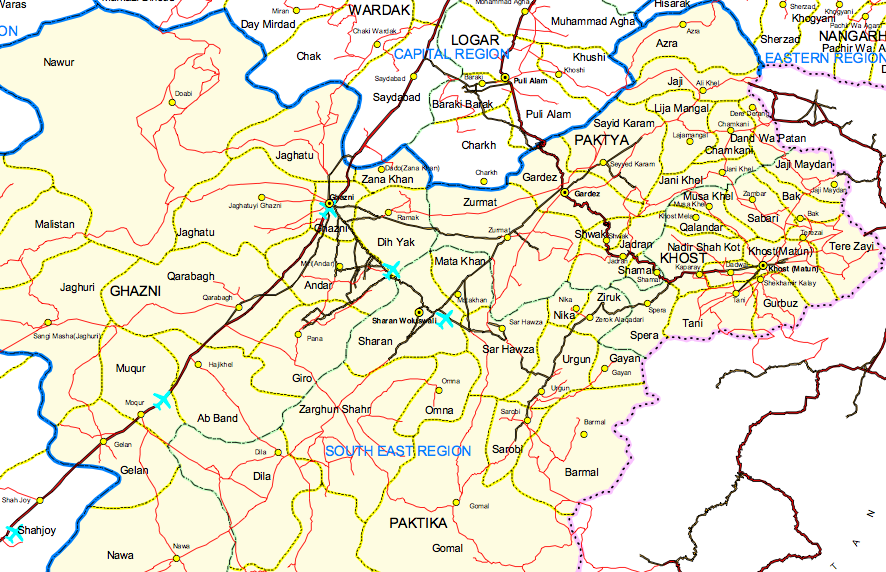
The Southeast Region - the next offensive is supposed to clear all of this
The Southeast Region – the next offensive is supposed to clear all of this with the forces on hand plus an extra 5,000 troop mini surge.


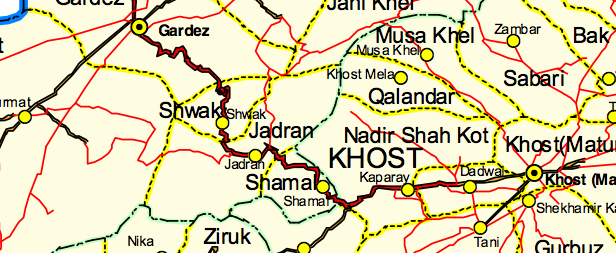
The Gardez to Khost highway - this tiny part of the Southeast Region
The Gardez to Khost highway – this tiny part of the Southeast Region took the Soviets 2 months to clear using 28,000 troops

Number comparisons between Soviet forces back in 1987 and American forces now are irrelevant. The Soviets had to dig out the thick belt of heavy weapons the Muj used to fortify the Satukandav Pass (30 km east of Gardez) using infantry fire and maneuver. Americans have drone pilots back in Nevada who could sort that out. Any Taliban fortifications uncovered by our side would get plastered by rockets and 2000lb JDAMS. That’s why the villains now use IED’s and when they do fight they do so in areas where there are lots of civilians so they can drop their weapons blend back into the normal pattern of life when hard pressed. The area between Highway 1 and the Pakistan border is huge and has heavily populated flat lands with lots of mountains in between.  It is not the Helmand Province where the Marines were able (with twice the manpower) to dominate the lower Helmand basin in large part because terrain, vegetation, and population density favored their direct fire weapon systems. That still took years for them to accomplish and I don’t want to get into what that effort cost in casualties because it is too damn depressing. It’s depressing because those sacrifices gained nothing that will last.

The reason I bring up Operation Magistral is not to point out the Soviets had 28,000 men and still got their asses kicked – they didn’t. The Paratroopers from the 82nd who are scheduled to conduct this offensive (if it happens as outlined in the article) won’t get their asses kicked either. But they’re going to take some casualties and they are going to inflict much more than they take and my question is to what end?

Brother _B_ and I were chatting on Skype earlier trying to figure out why ISAF would launch an “offensive” in a such a heavily populated area .  _B_ figures its to demonstrate the “capabilities of the Afghan Army we have been mentoring while creating space to withdraw”.  I agree – that is the classic reason to do this kind of operation but it also showcases the Pentagon’s steadfast refusal to deal with reality. The whole American COIN concept is predicated on having a legitimate host nation partner and our ability to build host nation security forces. We don’t have a legitimate host nation government to partner with and have failed to build meaningful capacity in the Afghan Security Forces (ANSF).

Bother _B_ and I know how this so-called offensive is going to end – we’re going to lose soldiers while killing scores of Pastun tribesmen and dozens of civilians. The second we pull out, the turf will go right back into the hands of the local Taliban and/or Warlord. That  is exactly what happened when the Soviets pulled out of the same area after inflicting a good thumping on the Muj back in 87. This planned offensive may well be the craziest idea floated by the American military since Operation Eagle Claw.

Crazy seems to be a theme lately because guess what those crazy Afghans are up to now? They’re threatening Hillary Clinton’s legacy! This is from the linked article;

Clinton embraced the cause long before the first U.S. troops landed in the country, and as secretary of State she has brought Afghan women worldwide attention, political power and unbending promises of American support.

“We will not abandon you,” she pledged.

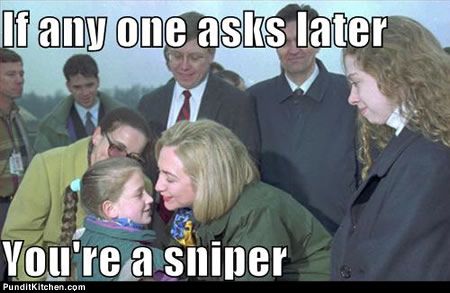
First; yes, you will abandon them, you already have in most of the country.  Second, what the hell does Hillary Clinton’s “commitment to women” have to do with the foreign policy of the United States of America? I’m all for helping Afghan woman and have done more than my share of projects in support of that effort. But I was working for an NGO which is the only appropriate vehicle for that kind of change. NGO’s work from the bottom up and can ignore or avoid corrupt officials if they are smart enough to understand cultural dynamics. Why is the office of the Secretary of State now a platform where liberal ruling class elites can indulge in imaginary pet projects designed to build a political legacy? Billions of our dollars and the lives of thousands of our fellow citizens hang in the balance in Afghanistan but the issue is Hillary Clinton’s legacy? The State Department had a lot to do with starting and shaping this conflict (if you break it you own it) while also underhandedly creating the dysfunctional central government by foisting their favored candidate and the SNTV voting system on the Afghan people.  Nobody seems to remember these facts nor the myriad unintended consequences of allowing senior people to dabble in the Great Game and leave others to contended with the fall out. The lessons that normally accompany abject failure are being swept under the rug instead of being mined how to not make the same mistakes in the future. Hillary Clinton’s legacy my rosy red ass….I’ve got her legacy right here;

I do not care for people who create tales of martial exploits in order to win high office because it reinforces the sad fact that they think the rest of us are stupid

Now that I got off my chest let me throw in some more pictures and get back on track. Check out the photos below:

The US Embassy entrance in 2005
The US Embassy entrance in 2005 looking towards Massoud Circle


School in nangarhar in 2005
Public school in Nangarhar Province 2005


The front entrance to the Embassy gate
The US Embassy entrance in 2012 looking from Massoud Circle back towards the gate; note the difference in security set up


Public School in Nangarhar 2012
Public School in Nangarhar Province 2012

Shortly after the first set of  pictures above were taken ISAF decided that we were going to do COIN and emphasize protecting the people. Every year since then the Taliban and other insurgent groups have grown stronger while not much has changed for the average Afghan. Yet ISAF and the American embassy have never stopped putting up more walls, more wire, and adding more movement restrictions which isolate diplomatic and aid staff even more than before.  Security for me but not for thee is what I had to say about this back in 2010, and not much has changed since. Admitting this seems to be problematic even for  the practical people of Australia. From the linked article:

Australian officials have rejected a report commissioned by the government agency AusAID that is critical of the security assessment in Afghanistan, insisting it be rewritten to match upbeat claims of dramatic progress.

What can you say about that bullshit? What I’d like to say to any Australian government representatives reading this post is that The Bot and I can do a 3 year Provincial security assessment, in any province mind you, for 2.5 million (Australian dollars please – they’re worth more than American dollars) and we’ll have teams on the ground in every district bringing in the ground truth within 96 hours of signing the contract. But we don’t do re-writes; that may seem a disadvantage based on the article above but look at this way: save a million here and million there and before you know it you have a huge budget surplus and are then politically strong enough to take the truth straight.  And that’s how you should want your security assessments….right?

Let me predict something and I know I’m right so don’t even think about emailing me asking to bet…you’ll lose. There will be no offensive by ISAF in eastern Afghanistan this year or next year or any year. The conventional military has done all they can do and it is time for them to leave. They think their fighting big T and little t Taliban but they’re wrong. What they are fighting is a Afghan insurgency because the Afghans don’t like foreigners and they don’t like the government in Kabul no matter who is charge. They know and have known for years that the only way to get a fair settlement in a land dispute or any civil law matter is to take the issue to a Taliban judge for adjudication. We have screwed this up so badly words are not adequate to express my level of disgust with what we have wrought on the Afghans.


Return to Kabul

Kabul is currently a tense place. It has had periods of unrest many times in the past (the 2006 riots that erupted after American soldiers caused a multi-fatality motor vehicle accident springs instantly to mind), but Kabul isn’t experiencing unrest – it’s tense like a tight spring. The endgame is near: internationals are no longer welcome in most parts of the country and are barely tolerated elsewhere. Armored SUVs, still the only way most internationals will travel in Kabul, are routinely stopped, and the legally licensed weapons of the international security consultants are confiscated. On a technical note, every weapon owned and licensed to PSC firms is now illegal because the Afghan Public Protection Force (APPF)  was supposed to take over the security duties from international PSCs last month, and that’s not remotely close to happening. For those who do have APPF guards on their compounds, the word is that the guards have no weapons and are not being paid by the APPF leadership. This is a surprise to whom? Nobody has a clue about how these things usually work out in Afghanistan.

Locals in Kabul are concerned about what will happen when ISAF and the international community withdraw. They are also disgusted with the US, ISAF, the UN, the big international reconstruction firms and the Afghan politicians who are looting the country. Who can blame them? I’m disgusted with the American politicians who are looting my country, too. Over here, the mob is inflamed by Koran burning and rogue shootings. In America, the mob is inflamed by a media-manufactured “racially motivated” shootings.  The New York Times prints articles about corrupt officials in Kabul and ponders aloud why they remain at liberty.  I’d like to know why Jon Corzine is still at liberty; he stole 1.6 billion dollars from his investors, making the millions his Afghan counterparts are pocketing pale in comparison. But we know why these men are free – politically powerful members of corrupt political machines never face the consequences of their actions.

With Kabul so tense we are spending most of our time in the compound tracking atmospherics with our local national staff.

The Koran Burning Apologies

It was not the apologies that were so bad, it was how they were made and what was said. Some regular Joe’s in Bagram made a mistake and placed Korans into an incinerator. Local Afghans saw this and, with the help of the soldiers, rescued the material. That’s the story – there is nothing else that needs to be said, and here’s why. We have an 11-year track record in Afghanistan of not only respecting cultural mores and traditions but of bending over backward to show that respect. Any accusation or remark by a senior Afghan official that we disrespect Islam or the Koran should have been met with an explosion of righteous indignation. And I mean eyes bugged out, frothing at the mouth, explosion of spitting right back at them, the years and years of evidence that such a charge is out of line. If there is nobody at the ISAF HQ capable of doing that, maybe we should consider forgiving the considerable tax debt of NBC news commentator Al Sharpton and send him over here to deal with the press.

Messaging

ISAF

The Taliban kick our ass every day on twitter - that's Big Army IO for you and that is yet another indicator that our military may be good at a lot of things but winning wars is not one of them
Social media is not a game for big bureaucratic PC centric battle staffs because even illiterate tribesmen can make them look stupid

The Mask of Command; Modern Marine Corps version
The Mask of Command: Modern Marine Corps version

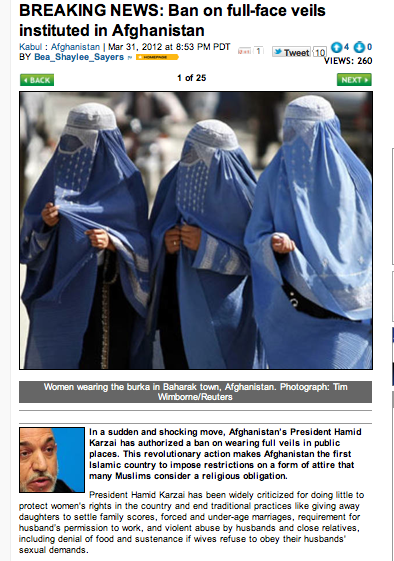
Pasted above are two recent examples of ISAF messaging; the first is self-explanatory, the second unexplainable. Let me take the second first and, to make it fair, let me stipulate the following. I’ll ignore the color of the Shalwar Kamise (the senior guy should be in all white) and ignore the man dancing (the senior guy doesn’t dance – he has subordinates that he can make do that) and focus on the venue.  Locked deep inside the most secure base in Southern Afghanistan, behind multiple secure entry points, is a prefabbed trailer with pictures of the Prez and the Queen, and no doubt President Karzai called the Afghan Cultural Center.

The Commanding General wanted to thank the Governor of Helmand for all the great teamwork that has made his year-long tour so successful, and he does this inside a gigantic Marine base where he established some bullshit “cultural center”?  You know what that makes him look like in the local context?  Weak.  If he wanted to put on local clothes and spend the night man dancing to thank the governor for such a great year on the ground, he should have had the balls (and G2) to go to the Governor’s compound.  At least he would have been in a real Afghan room, listening to real Afghan music while eating real Afghan food, and, most importantly, demonstrating some confidence in the improved security that was the cause of this silly celebration in the first place.

The Big Picture

Is there a reason for us to stay in Afghanistan?  No, there’s not, but I’ve been saying that for years.  Should the military be packing up and going home?  It will take until 2014, and probably well beyond, just to retrograde all the equipment and personnel from the theater, and I doubt there is much they can do to speed up the process.

Should we stop doing night raids?  Yes – I’ve been saying that for years too, and I don’t care how many phone conversations of panicked Taliban ISAF intercepts or how many senior guys they kill because it doesn’t matter. Every month the Taliban spreads, every month the number of successful IED strikes goes up, every month more Afghan government officials are assassinated. If these are indicators that the night raid tactic is working, what are the indicators that it’s not?  I think the reason we do night raids is that we have a huge, expensive, specialized operations apparatus that specializes in them.  When you’re a hammer, every problem looks like a nail, right?

April Fools

But night raids aren’t my problem today…this is, and I took a screenshot just in case the story disappears from the web.

If this isn't a joke us internationals in Afghanistan are in big trouble
If this isn’t a joke us internationals are in big trouble

Breaking News: Ban on full-face veils instituted in Afghanistan may be the only good news I’ve seen from the country this month.  Somebody here has developed a serious sense of humor combined with an understanding of irony and fooled the Western media with a fake news story. If (and I can’t see how) but if, the central government tried to force Afghan women out of the Burka, the appropriate Immediate Action Drill for all foreigners would be to head to the Kabul airport and fly out with the clothes on your back. Any attempt to go to ground in a safe house or delay your departure a day or two would be suicidal. That’s how disruptive the topic of women and their place in society is in Afghanistan.

To those Westerners, the treatment of Afghan women is so uniformly dismal that it is unbelievable. You want to see the ANP respond to a police call with true alacrity? Phone in a report of an unescorted teenage girl talking to a male who is not her relative. I’ve seen that kind of call play out before, and it’s not pretty. In fact here’s a story from yesterday about just how strongly locals feel on the issue:  Boy and Girl killed in Afghanistan acid attack ‘over friendship’. But to Afghans, the treatment of women in this country and boys who befriend them outside the conventions of social mores is the way it is supposed to be because it’s the way it has always been. That will change when the Afghan people want it to, and there is very little any one person or country can do to speed up that process.

How women are treated in Afghanistan may be something our progressive leaders believe is worth fighting for, but it’s not. You cannot change 6,000 years of cultural practice by force, because cultures double down when under attack from outsiders.

That fake news story would be hysterically funny, but it could also set off violent rioting that would target Westerners. Let’s hope it disappears fast.

Verified by MonsterInsights